
WhatsApp Business API Pricing: Meta Fees, Platform Costs & Budgeting
"What is this actually going to cost?" is the first question every team asks about the WhatsApp Business API — and the one most providers answer least clearly. Pricing pages bury platform fees in "contact sales," Meta's rate tables live in separate documents, and the real bill depends on a pricing model most buyers have never seen before.
This guide breaks WhatsApp Business API costs into their actual layers, names the costs vendors rarely volunteer, and gives you a budgeting framework you can defend to your CFO. Meta adjusts its fee schedule periodically — always confirm current rates on Meta's official pricing pages — but the structure below is stable, and understanding it is 80% of the battle.
The three layers of WhatsApp Business API cost
Layer 1: Meta's message fees. Meta charges directly for business-initiated template messages, priced per message and grouped by category:
- Marketing templates — promotions, product announcements, re-engagement campaigns. The most expensive category.
- Utility templates — order confirmations, delivery updates, appointment reminders, account notices. Usually much cheaper than marketing.
- Authentication templates — one-time passcodes and login verification. Priced separately, often competitive with SMS OTP.
Two structural rules matter more than any single rate:
- [ ] Conversation categories changed the old model. Meta moved away from the original 24-hour "conversation" bundles toward per-message pricing for business-initiated templates — check the current rate card for your market, because rates vary meaningfully by country.
- [ ] Customer service replies inside a 24-hour window are free. Once a customer messages you, you can reply free-form for 24 hours at no Meta template fee. This is why conversation-led funnels (ads, chatbots, inbound support) are structurally cheaper than blast campaigns: your revenue conversations ride on the free window, and you pay template fees only when you initiate.
Layer 2: The platform (BSP) fee. Businesses don't connect to the WhatsApp API directly — they go through a Business Solution Provider (BSP) like GeneX. Platform pricing models vary wildly across the market:
- [ ] Per-seat SaaS subscriptions (predictable, scales with team size)
- [ ] Message markups (a margin added on top of Meta's fee — the least transparent model, and the one to push back on)
- [ ] Tiered bundles with caps and overage rates
- [ ] "Free" tiers that monetize via message markups or locked features
The critical due-diligence question for any provider: "Do you pass Meta's fees through at cost, and will you show me the Meta fee lines on my invoice?" A provider who hesitates is probably marking messages up.
Layer 3: The hidden costs nobody puts on the pricing page. Budget for these or get surprised:
- [ ] Onboarding and verification assistance — some providers charge hundreds of dollars for what others do free
- [ ] Number hosting and multiple numbers — per-number monthly fees add up for multi-market teams
- [ ] Integration and webhook engineering — your developers' time, or the vendor's professional services rates
- [ ] Template rejection cycles — every rejected template delays campaigns; repeated rework is a real (invisible) cost
- [ ] Per-feature paywalls — AI agents, analytics depth, API call caps, seat minimums
A budgeting framework that survives finance review
Step 1: Split your messaging by intent. List every message type your business will send, and classify each as marketing, utility, or authentication. Most teams discover 60–80% of their volume is utility (confirmations, updates) — the cheap category. This one exercise usually destroys the "WhatsApp is expensive" myth inside your own company.
Step 2: Model the free window aggressively. Every flow that starts with the customer messaging first (ads, website chat widgets, support inbound) generates free replies. Design funnels to pull rather than push: the economics improve immediately.
Step 3: Price your market, not a global average. Meta's per-message rates differ by country. If you operate across markets, build a per-market cost row — a campaign that is cheap in Southeast Asia may cost multiples in Western Europe, and vice versa.
Step 4: Add the platform layer honestly. Seats + numbers + any feature add-ons, plus a 20% buffer for the hidden costs above.
Step 5: Benchmark against the channel you are leaving. The fair comparison for authentication messages is SMS OTP (WhatsApp is usually cheaper and converts better). For marketing, the comparison is email and paid retargeting — where WhatsApp's read rates are in a different league. Cost per message is not the point; cost per outcome is.
How GeneX prices this — and why
Because we believe this stuff should be legible:
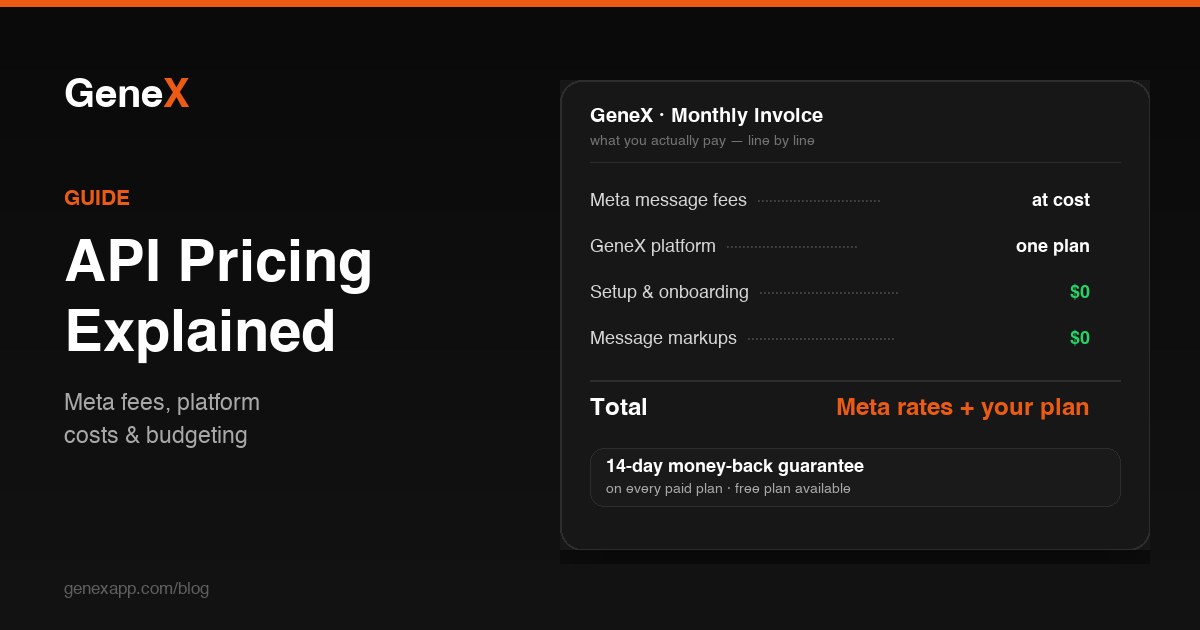
- [ ] Meta's message fees pass through at cost. You see Meta's fee lines separately on your invoice. No markup on traffic.
- [ ] GeneX charges one transparent SaaS subscription for the platform: team inbox, campaigns, automation, integrations, and support. Annual plans only, with a 14-day money-back guarantee so you can verify the economics on your own traffic before committing.
- [ ] No onboarding fees for standard setup. Business verification guidance, template review support, and number connection are part of the service.
The result: your cost curve is Meta's published rates plus a known subscription. When Meta changes its rates, your bill changes by exactly that much — nothing hidden in between.
The provider evaluation checklist
Before signing with any BSP, get written answers to:
- [ ] Are Meta fees passed through at cost, itemized on invoices?
- [ ] What is the total first-year cost for your projected volume and seat count (fees + subscription + add-ons)?
- [ ] Which features are paywalled: AI, analytics, API access, webhooks, multiple numbers?
- [ ] What happens to your number and templates if you leave? (Portability is leverage.)
- [ ] Is there a refund or trial window to validate costs on real traffic?
Work out your numbers with us
We will map your message volume to Meta's current rate card and show you the exact cost structure before you commit to anything.
Compare pricing plans or talk to our team — bring your volume estimates and we will do the math with you, line by line.
WhatsApp and Meta are trademarks of Meta Platforms, Inc. Meta's message fee categories and rates change periodically; this article describes the pricing structure, and current rates should be confirmed via Meta's official pricing documentation. GeneX operates on the official WhatsApp Business Platform as an authorized Meta Business Partner.
Related articles
Ready to run these plays yourself?
Get started with GeneX — the free plan is live today, and every paid plan is covered by our 14-day money-back guarantee.